From Bankruptcy to Backbone: Rethinking How Track and Field Scales
I originally wrote this on 12/22 as an early solution sketch for the sport. Since then, my thinking has shifted. I’m now much more focused on World Athletics and the governance layer that controls what “counts” in track and field, because that structure shapes what’s possible for any “league” or platform play. I’m keeping this piece published as a snapshot of my first pass, not my current thesis.
I don’t know how it happened, but I’ve developed a real love for track and field. Until recently, the Olympics were the only time I ever watched a race. I actually tried out for track in high school once and nearly puked in the process but I digress. Every other attempt to get into the sport ended the same way. I’d try to watch, get overwhelmed in about two minutes, and bail. I had no idea where to start, who mattered, or how to follow events outside of the Olympics like the Diamond League, NCAA championships, or indoor circuits.
So I did the only thing that was easy. I went to YouTube and rewatched Usain Bolt races. On repeat.
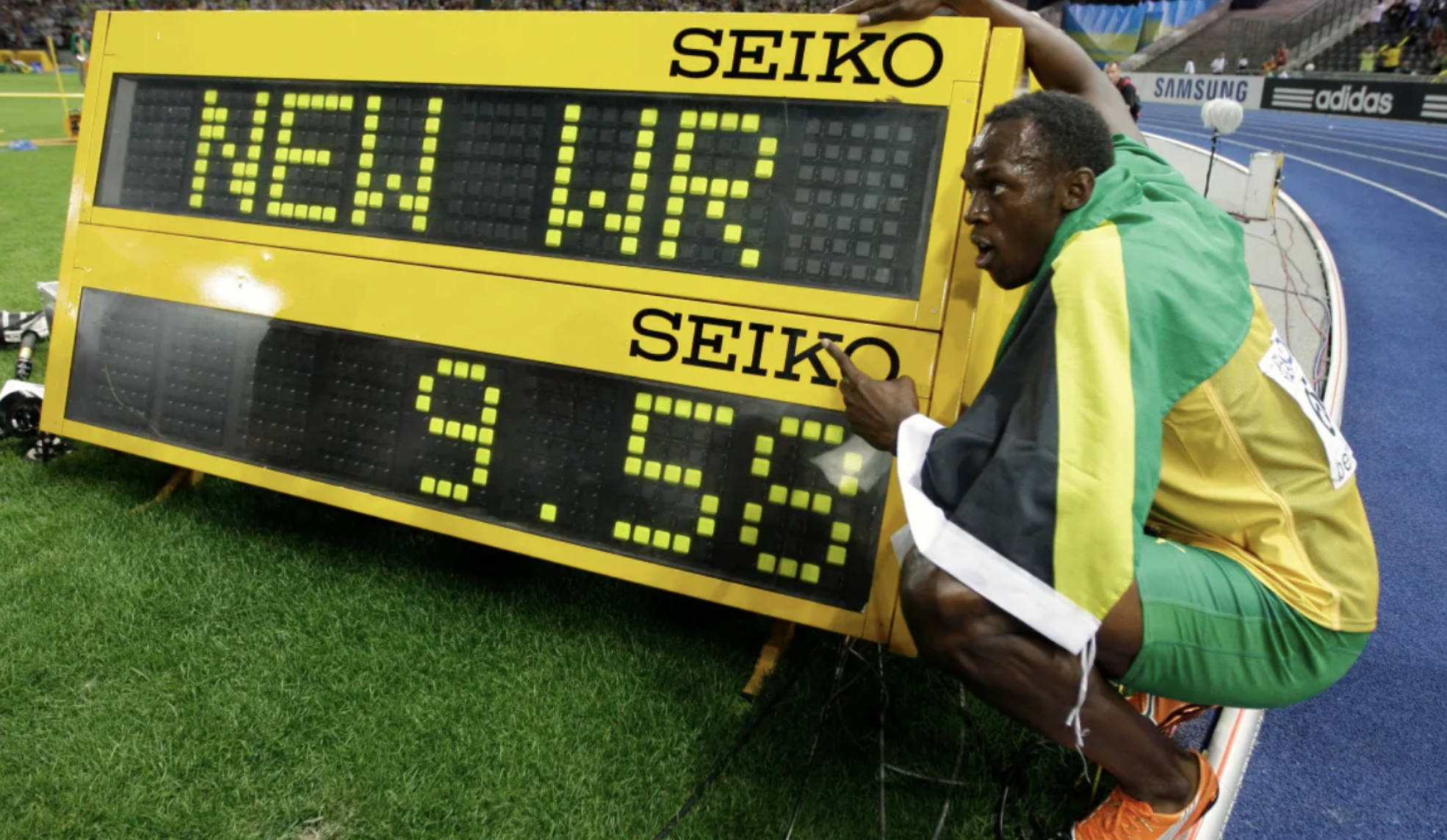
Running 100m in 9.58 seconds is insane and won't happen again for a long time
A handful of track and field YouTube channels eventually pulled me in. I started learning the athletes, the events, the rivalries. Now that I’m on the inside, the real problem is impossible to ignore. The sport has a massive infrastructure gap.
Case in point. The Jim Mitchell Invite happened this past Saturday. The only reason I knew it even existed is because Coach Rob from Scholar Champion Athlete Recruiting mentioned Quincy Wilson running the 500m and 55m dash. When I looked up the rest of the field, I got super annoyed. Port Chester. New Rochelle. Ramapo (my alma mater). Clarkstown North. All schools I know! An event I absolutely would’ve gone to or at least watched....but didn't even get a chance to.
I didn’t miss it because I wasn’t interested. I missed it because the system never told me it was happening.
Diagnosis: Constraints Revealed by GST 1.0
Michael Johnson's original vision for Grand Slam Track was correct in its diagnosis: the sport lacks a cohesive narrative. However, the first iteration acted as a high-stakes stress test that revealed the deep structural constraints of building a walled garden league within a fragmented, federated ecosystem.
These constraints weren't failures of ambition; they were symptoms of the sport's current architectural limits:
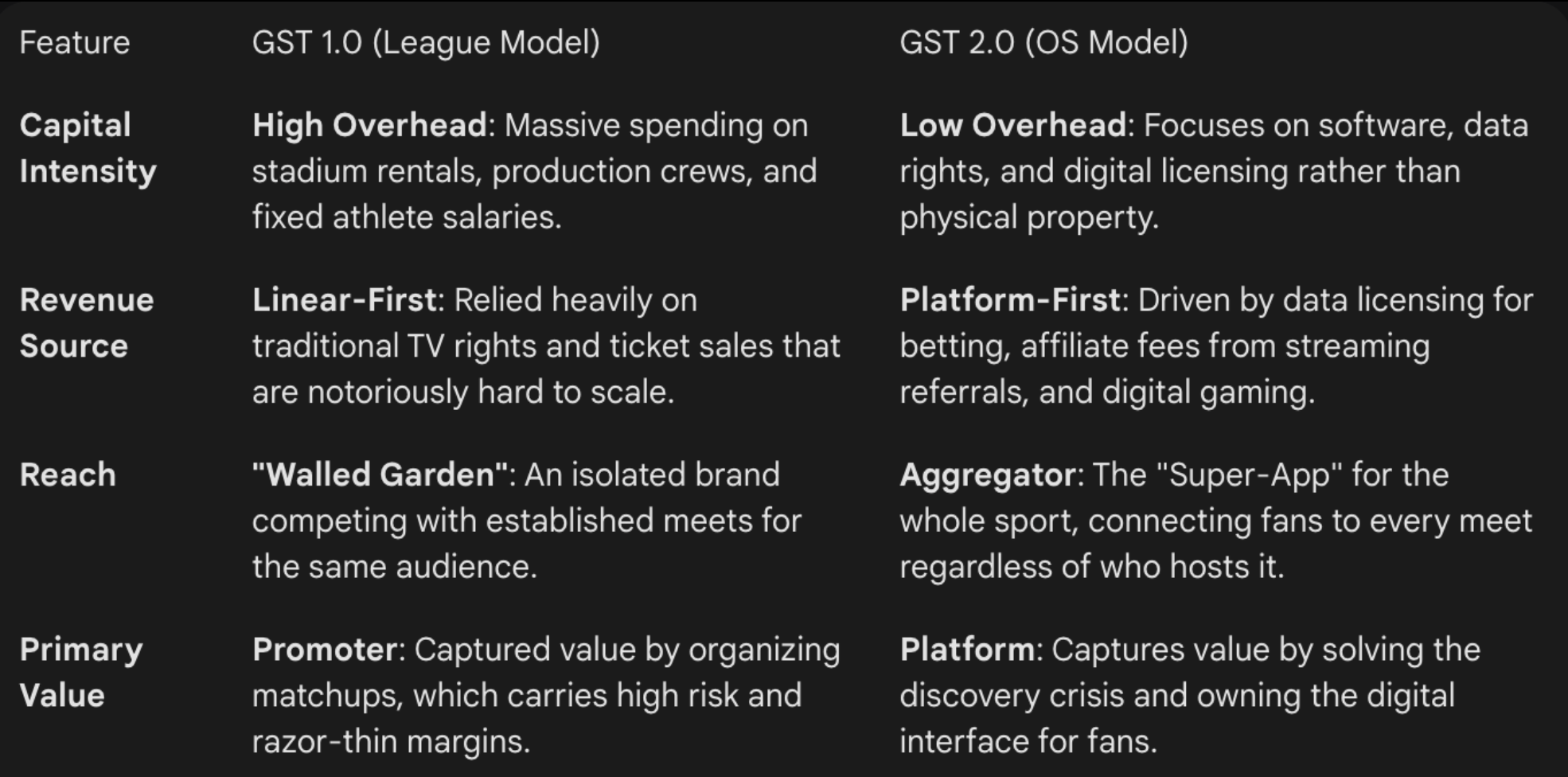
The Scalability Ceiling: Relying on a capital-intensive event model (stadium rentals and high-production broadcasts) created a high burn rate vulnerable to sudden shifts in investor sentiment.
The Fragmentation Trap: Track and field fans are currently scattered across disparate platforms—Peacock, FloTrack, and YouTube—making it difficult to build a habitual linear audience without a centralized discovery funnel.
Fixed Cost Inflexibility: Large athlete guarantees and multi-day event overhead created a rigid financial structure that struggled to pivot when cornerstone funding was withdrawn.
The Trust Gap: The resulting multi-million-dollar liabilities to athletes and vendors highlighted that the sport's economic engine needs a different fuel source than purely external investment.
The Core Insight: GST 2.0 as the Operating System
The path forward isn't to build a bigger league. It's to build the Operating System (OS) that makes the sport's hardware—the meets, the athletes, and the timing data—actually work together.
GST 2.0 should pivot from being a Promoter to a Platform. In this model, you don't need to own the stadium to monetize the race. You own the interface through which the world interacts with the sport.
The OS Model vs. The League Model
Phase 0: The Infrastructure of Independence
Before relaunching events, we have to build the digital backbone that makes revenue self-sustaining. Each of these optional revenue layers only works once discovery and data are centralized.
The Track Pass Discovery Engine: A unified app serving as the TV Guide for track, deep-linking fans to wherever the sport is happening. This captures affiliate revenue from streaming partners.
Centralized Data & Betting Hub: Partnering with timing companies to standardize a real-time data feed API. This turns raw performance into a high-margin asset sold to sportsbooks for in-play betting.
The Narrative Engine (Fantasy): A season-long fantasy platform that rewards fans for following athletes across the global calendar, not just Slam events.
Equity-Driven Trust Rebuilding: Addressing athlete liabilities by offering equity in the GST 2.0 technology platform. This converts key stakeholders into partners who are financially incentivized to help the OS succeed.
Feasibility: Navigating Friction and Governance
Building an OS requires navigating the interests of World Athletics and USATF, who have already warned that a return isn't guaranteed without a "sustainable, solid financial model".
By positioning GST 2.0 as a revenue-multiplier—driving more viewers to Peacock or increasing the betting "handle" for independent meets—the "Operating System" becomes an indispensable partner to these bodies rather than a competitor.
Conclusion: The Path to Independence
The financial collapse of GST 1.0 was a testament to the danger of trying to force supply (events) before engineering demand (discovery).
Michael Johnson doesn't need a bigger investor or a flashier broadcast deal. He needs to build the connective tissue that makes the sport scalable. By building the Operating System first, GST 2.0 ensures that any future championship finale sits on a foundation of independent, profitable growth.